✦   Exchange your Barsana heirloom silk saree after one year and step into your next heirloom.

The Archive

A Living Museum of Indian Textiles

Explore the rich tapestry of India’s regional weaving traditions, where each state contributes its unique voice to the chorus of handloom heritage.

Regional Weaving Traditions

Each region of India has developed distinctive weaving techniques shaped by
climate, culture, and centuries of tradition.

Bengal

The land of Jamdani muslins and narrative Baluchari silks, Bengal’s textile heritage is woven into its very identity.
Bengal’s handloom tradition dates back over 2,000 years, with Jamdani muslins once so fine they were called ‘woven air.’ The Baluchari weave tells stories from Hindu epics through intricate pallav designs, while Kantha embroidery transforms simple cotton into narrative art.

Varanasi

The holy city’s silk tradition interweaves spirituality with craftsmanship, creating fabrics worthy of the divine.
For over 400 years, Varanasi’s weavers have created some of the world’s finest silk brocades. The kadwa technique, unique to Banarasi weaving, creates individually woven motifs making the fabric reversible. Mughal patronage enriched the tradition with Persian and Islamic motifs.

Gujarat

From the double ikat Patola to the tied and dyed Bandhani, Gujarat’s textiles celebrate geometric precision and vibrant color.
Gujarat’s textile heritage includes the rare double ikat Patola, where both warp and weft threads are resist-dyed before weaving. Bandhani tie-dye involves tying thousands of tiny knots before dyeing. Bhujodi weavers create striking geometric patterns using traditional pit looms.

Maharashtra

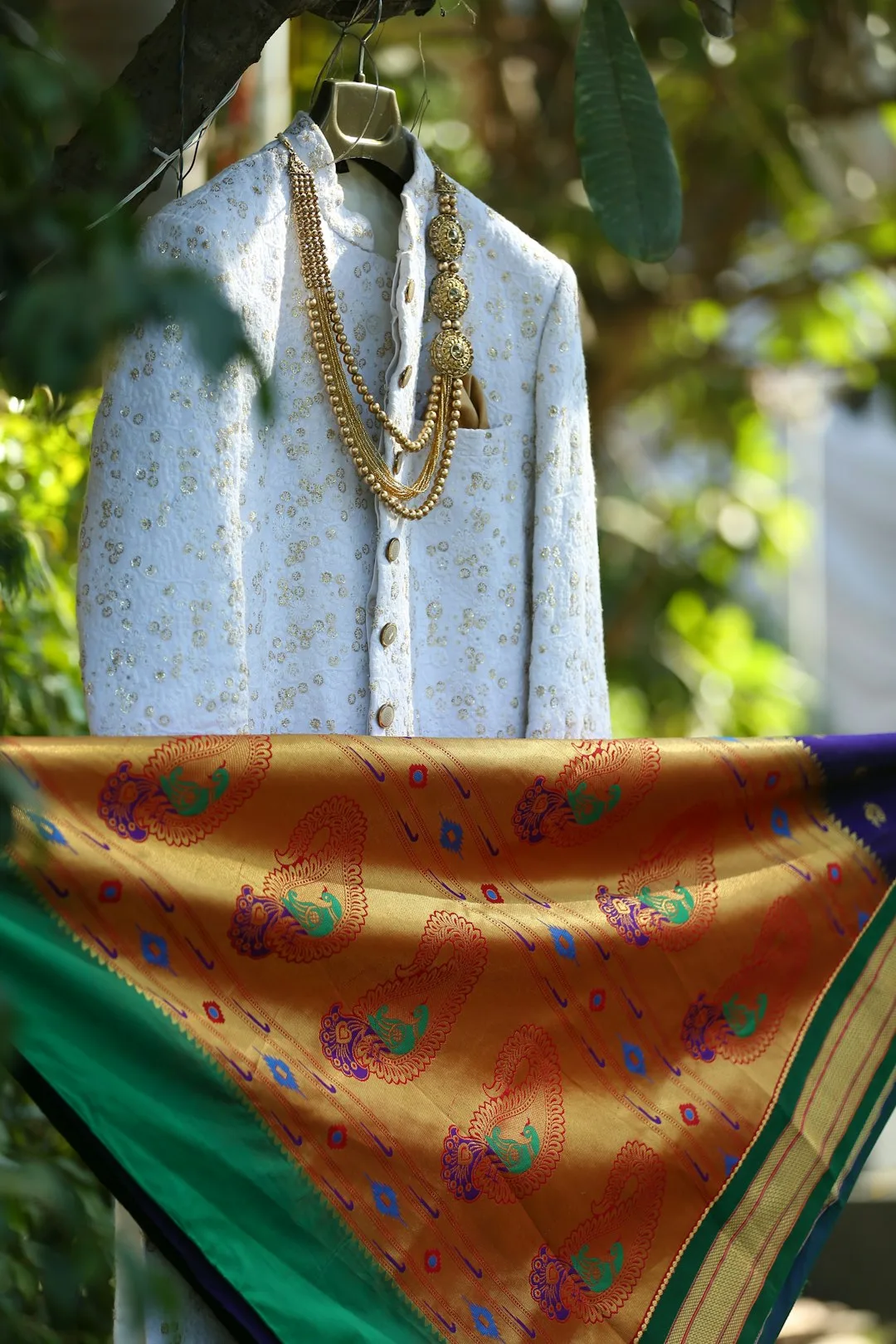
Paithani’s peacock motifs and pure silk radiance make it one of India’s most treasured weaves.
Paithani weaving dates back 2,000 years, with mentions in ancient texts. The characteristic peacock and lotus motifs are woven using the tapestry technique. Pure gold zari threads create the distinctive pallav, with some antique Paithanis using real gold.

Andhra Pradesh

From hand-painted Kalamkari to the resist-dyed Pochampally ikat, Andhra Pradesh offers diverse textile traditions.
Kalamkari, meaning ‘pen work,’ uses natural dyes and bamboo pens to create intricate mythological narratives. Pochampally ikat involves resist-dyeing threads before weaving, creating blurred, artistic patterns. Mangalagiri cotton is known for its zari borders on pure cotton.

Tamil Nadu

Kanchipuram silk, known as the ‘Queen of Silks,’ represents South Indian textile excellence.
Kanchipuram has been weaving silk for over 400 years, with the temple town’s weavers creating sarees known for their durability and heavy silk. Traditional designs feature temple motifs, checks, and stripes. The body, border, and pallav are often woven separately and then interlocked.

The Archive

Motifs & Their Meanings

Every motif woven into a saree carries symbolic meaning, connecting the wearer to
centuries of cultural wisdom.
Shop
Search
Account
0 Wishlist
0 Cart
Shopping Cart

Your cart is empty

You may check out all the available products and buy some in the shop

Return to shop